
At Herveda Botanicals, indigenous knowledge, local medicinal plants, and scientific research aren’t separate stories—they’re formulated into one, bottle by bottle. Dr Prativa Pandey
Beauty Rooted In Knowledge, Grown In Science
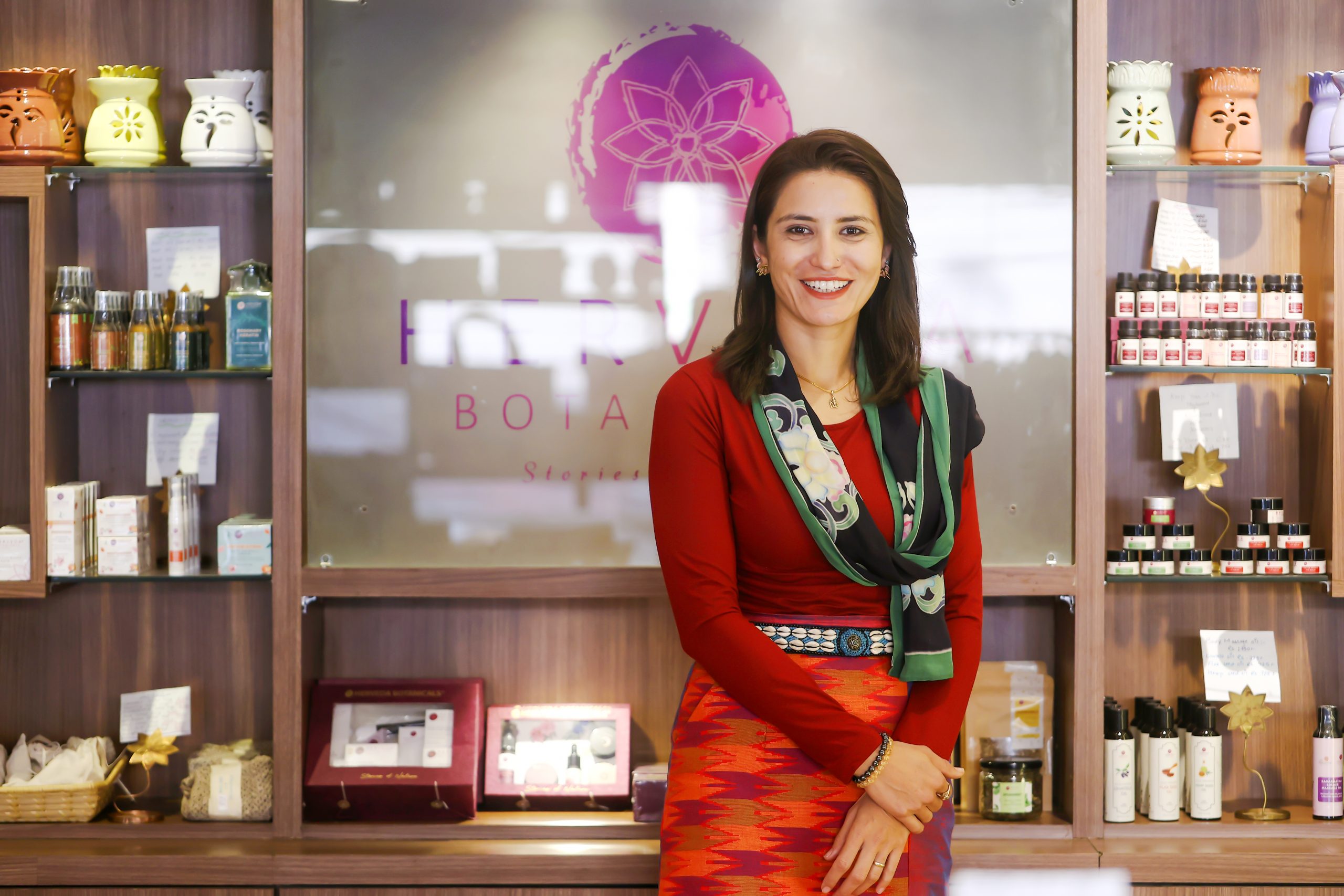
Nepal’s hills and mid-elevation valleys hold a long, working relationship between people and plants: rice and turmeric ground into a scrub, marigold gathered for worship and skin alike, chiuri fruit rendered into a butter for cracked winter skin. For me, that relationship became the starting point of a company. A chemist by training, I returned to Nepal from the United States in 2015, in the aftermath of the earthquake, and in 2017 founded Catalyst Technology, a research and product-development firm focussed on adding value to Nepal’s medicinal and aromatic plants (MAPs). Herveda Botanicals, the skincare and wellness brand she launched as its spin-off in 2019, is what that research became.
Plants, People, and Science
Herveda’s guiding idea is less about any single ingredient and more about connection: bringing indigenous knowledge, Nepal’s native plants, and modern science together in one product, so that each one carries a piece of the country’s story. The Ko Foaming Rice Exfoliant grew out of that approach—I documented ‘Ko’, a traditional rice scrub finding its roots in the Newa community, alongside a related exfoliant called ‘Bukuwa’, before refining the recipe with contemporary formulation science. The Marigold Hydration Mist works the same way, drawing on marigold’s place in Nepali worship and cultural ceremony. For Herveda, a product is as much a way of introducing Nepal and its traditions to a customer as it is a piece of skincare.
Growing What the Formulas Need
To keep pace with that philosophy, Herveda runs a biodiversity research farm in Champi, Lalitpur, dedicated to growing high-quality raw material for its own formulas. Calendula, the flower behind the Marigold Hydration Mist, is grown there, alongside rosemary used across the brand’s haircare line. The farm’s purpose goes beyond supplying Herveda directly: it is also where the company develops high-quality plantlets and seed stock, which it then shares with farmers it partners with to grow herbs at scale. Those farmers are brought on with a buy-back guarantee and fair pricing, so that taking on a new, less familiar crop doesn’t come with the market risk a farmer would otherwise carry alone.
Herveda uses rare medicinal orchids propagated sustainably in also maintains a tissue culture laboratory for their extracts—a way of using plants that would otherwise be vulnerable to over-harvesting in the wild.
Fair Value for Local Hands & Rooted in Community
That same principle—that people close to the source should share fairly in the value created downstream—runs through how Herveda sources more broadly. The company buys raw materials directly from farmers and indigenous producers at market price, cutting out the layers of middlemen that typically leave growers with only a small share of what their materials are eventually sold for. Essential oils are sourced directly from farmers and farmer cooperatives, and beyond its own farm and buy-back partnerships, Herveda works with home-based women workers who produce items such as soaps, traditional lokta boxes, and candles sold alongside its skincare line.
Herveda also partners with other like-minded organisations on a similar basis. One ongoing collaboration sources chiuri, the fruit butter used in products like the Daily Defense Moisturiser, from the Chepang community. Beyond simply buying their chiuri, the partnership includes skilling members of the community—building their capacity alongside the trade itself, so the relationship supports the community rather than only its raw material.
Formulating with Evidence
Alongside this community-facing work, our research runs on two tracks: documenting indigenous and Ayurvedic knowledge—including conversations with Aamchis, traditional healers from Nepal’s Tibet-bordering regions—and the formulation chemistry needed to turn that knowledge into a stable, testable product. Herveda’s products are sent for third-party laboratory testing before launch and are formulated to meet U.S. FDA cosmetic requirements, a step tied to a longer-term goal of exporting Nepali-made skincare rather than only importing finished products into Nepal.
That combination of heritage and evidence is what customers have responded to over the years—long-time users point to the Ko scrub, the day and night creams, and a chiuri-butter-based line developed for pregnancy and postpartum skin among their long-standing favourites. But for us, the products are the outcome, not the point: the mission is what they carry with them—a documented piece of Nepali knowledge, a farmer or community paid fairly for their part in it, and a story about Nepal that a customer takes home along with the bottle.
Recognition and What’s Ahead
My work has been recognised through the OWSD-UNESCO Early Career Fellowship (2019), which supported my research into green extraction of bioactive compounds, the NAST-NABIL Science and Technology Award (2019), and the South Asia Woman Entrepreneur of the Year Award (2022). I was also featured in UNESCO’s Virtual Science Museum’s Women in Science initiative. Today, I am exploring herbal supplements and see Catalyst Technology playing a role in certifying and standardising Nepali formulations for export. My larger goal is to help Nepal turn its rich botanical resources into higher-value finished products rather than exporting raw materials.
What Herveda Is Building Toward
Connection: Indigenous knowledge, Nepali plants, and science, brought together in one product.
Storytelling: Introducing Nepal and its traditions to customers through what’s in the bottle.
Shared value: Fair pricing, buy-back guarantees, and direct sourcing for the farmersand communities behind the raw material.
Conservation: Propagating rare medicinal orchids through tissue culture rather than wild harvesting.
Dr. Prativa Pandey is the Founder and CEO of Herveda Botanicals, a Kathmandu-based skincare, haircare, and wellness company built on Nepal’s native plants, traditional knowledge, and modern science. She holds a PhD in Organic Chemistry and nanotechnology, from the US, and her work has been recognised with the OWSD-UNESCO Early Career Fellowship, the NAST-NABIL Science and Technology Award, and the South Asia Woman Entrepreneur