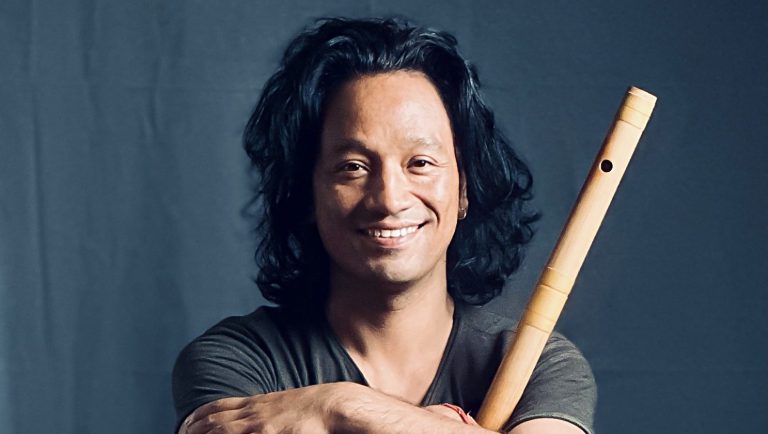
For Manose Newa, music is “a stepping stone towards realising divinity”—a practice of meditation, presence and self-discovery found in every breath of the bansuri. SHINE Edit
Between Breath and Divinity
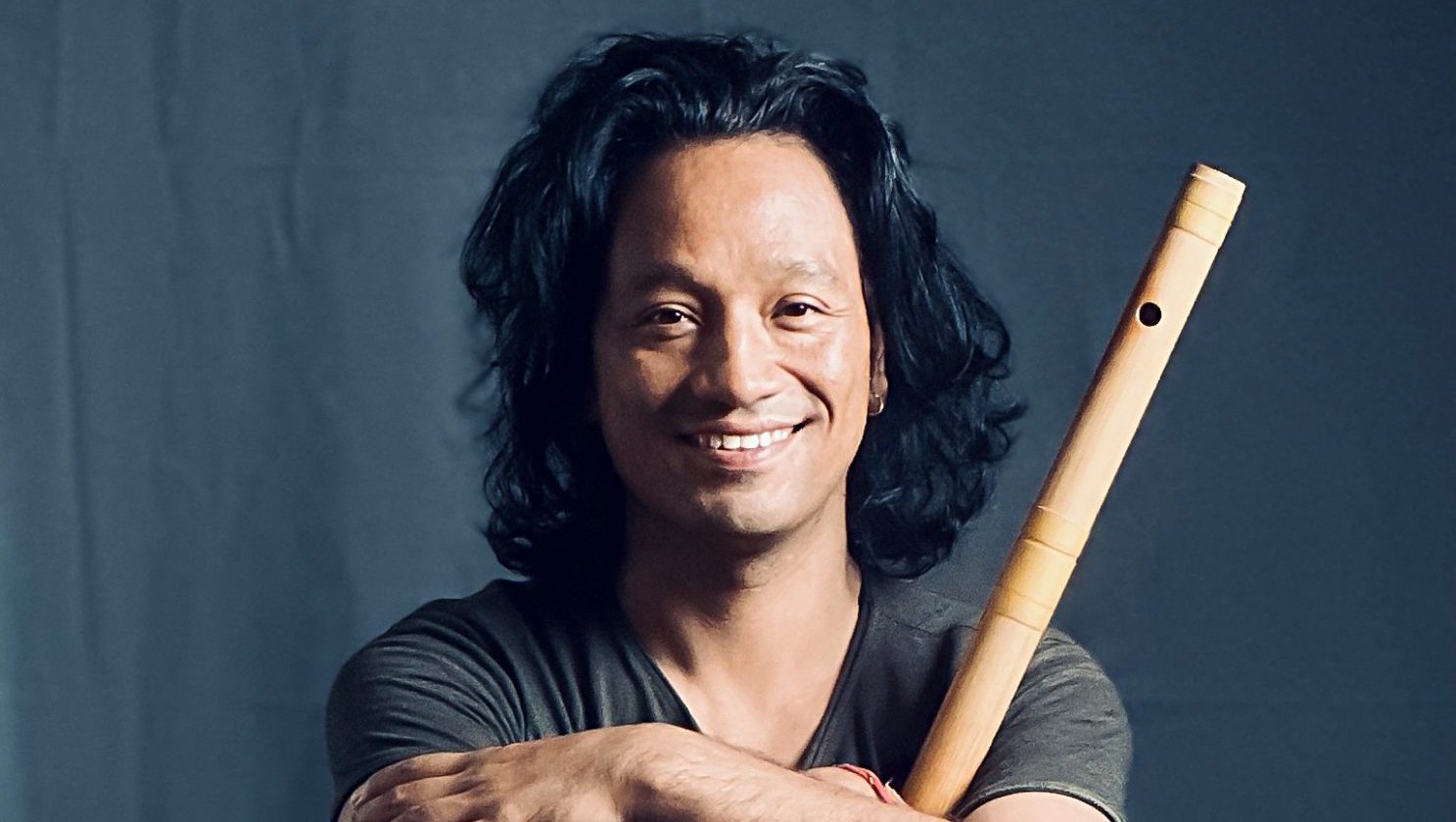
The first time I heard Manose’s flute in Pinjada ko Suga, I heard novelty, but now, I hear intention.
When people first encounter Nepali fusion music, especially that of 1974 AD, it is easy to think that Manose’s flute is what makes their music sound “so different.” But that would be underselling what he is doing. When I returned to Pinjada ko Suga with a more attentive ear, the flute no longer sounded like an addition to a rock song. It sounds like the song has been built with the flute already in its DNA.
Listening to the music now, years after first encountering the song, I hear a musician quietly following a language he has been speaking for most of his life. For Manose, that language began with a sound he still cannot fully explain.
Decades ago, as an 8-year-old growing up in Boudha, he had experienced what he describes as a “very mysterious” sound. One night he was unable to sleep when, from his room, with the Boudhanath stupa visible outside his window, he suddenly heard something he could only describe as otherworldly. “I don’t know if I was sleeping or dreaming,” he recalls. “How could something be so beautiful?”
Today he believes it may have been Krishna playing the flute.
Whether it was Krishna himself, the experience left an impression that never quite went away. He began searching for that sound, and the bansuri came closest. “It isn’t the exact sound, but still, it is something that when somebody plays it, I feel that longing even more.” This longing seems to sit at the heart of Manose’s relationship with music.
It is what drew him towards the bamboo flute, what kept him playing it everywhere he went, and perhaps, what continues to drive his constant exploration of sound. He describes his early relationship with the instrument almost like an obsession. “You’re obsessed. You’re possessed by it,” he says, before adding, “which is a wonderful thing.”
The simplicity of the bansuri only deepened the attraction. There is no elaborate machinery behind it: just bamboo, breath, and the musician. For Manose, that simplicity is part of its power. “There’s nothing hidden in it,” he says. “It’s made of bamboo. It is so simple. It is accessible anywhere you want.” Yet simplicity does not mean limitation.
Growing up around Boudhanath and later playing at places such as the gates of Pashupatinath, music became intertwined with a sense of culture, devotion and inner practice. For Manose, classical music is not necessarily “spiritual” in the conventional sense; he speaks instead of invocation, sadhana, shraddha and bhakti. Playing before sacred spaces gave him a way of approaching music with reverence, while his classical training gave direction to an instinct that had begun much earlier.
He remembers wanting guidance even while playing at Boudhanath. His first guru, Madan Dev Bhatta, eventually provided that direction. To Manose, a guru is someone who “shows light.” The relationship between student and teacher became another important part of his musical journey, not simply as a means of learning notes, but of learning how to listen, feel and approach music. That foundation would later allow him to move comfortably between worlds.
As one of the musicians who helped bring the bansuri into the rock landscape of Nepal through 1974 AD, Manose became part of a musical conversation that was, at the time, relatively unfamiliar. The flute could have been treated as an exotic addition to rock. Instead, it became part of the vocabulary. His classical grounding gave him the freedom to enter rock, jazz and world fusion without abandoning the musical identity he had grown up with. That instinct—to expand rather than separate—has remained central to his work.
With Sukarma, he pursued another version of the same idea: how could classical raga reach people beyond the traditional concert hall? His answer has never been to dilute the music, but to find ways of making it more accessible. “If I can’t beat them, I’ll join them,” he says, speaking about collaboration and the possibilities of bringing different musical worlds together.
It is an approach that seems to define Manose beyond any single genre. He speaks enthusiastically about putting good people together, collaborating with artists and discovering what becomes possible when musicians stop thinking of their instruments as competing for attention. “Every instrument is shining in its own way,” he says.
His career has taken that philosophy far beyond Nepal. A Grammy nomination for Deva became one of those moments when a personal musical journey intersected with a larger global stage. Yet his reflections on music remain surprisingly grounded. He talks less about achievement than about possibility, connection and the ability of music to cross barriers.
Perhaps that is why he describes the flute as a language.
He has played it everywhere he has gone, allowing its sound to communicate where words might not. And for him, improvisation belongs to that same realm of possibility. It can be taught, but not conventionally. Beyond scales and technique are what he calls the “notes of kindness, compassion, love.”
It is a particularly revealing way of describing improvisation. For Manose, music is not simply about what the fingers know. It is about what the person carrying the instrument has learned to feel.
There is an almost meditative quality to that philosophy. He speaks about being present in every moment, every breath; about creating a comfortable space in which you can listen to yourself. “Celebrate yourself,” he says. “It’s really important to be present, be kind, and compassionate.”
That idea of presence has followed him through some of his most extraordinary experiences. In his late thirties, while performing in Russia, he describes having an unexpected out-of-body experience while playing. It was unlike anything he had experienced before, something he still cannot explain. He is careful not to claim a particular spiritual identity or explanation for it. Sometimes, he suggests, an experience simply arrives.
Perhaps that is the mystery he has been chasing since he was eight.
The sound itself may never have returned in exactly the same form. He still has not heard that mysterious sound from his childhood again. But instead of treating that as something lost, Manose appears to have spent his life pursuing it through the flute: through classical raga, rock, collaboration, improvisation, songwriting and performance.
During the pandemic, he began writing extensively in Nepali. He even took on the challenge of singing after someone remarked that flute players cannot sing. Once again, the instinct was not to stay within a familiar boundary, but to see what lay beyond it.
That may ultimately be the most compelling way to understand Manose Newa: not as a musician who found one sound and mastered it, but as an artist who continues to follow the possibility of sound itself.
And so I return to Pinjada Ko Suga.
The flute enters the rock arrangement, and for a few moments the boundaries between genres become almost irrelevant. There is only breath, bamboo and melody. Listening closely, I find myself thinking about the eight-year-old boy in Boudhanath who woke up wondering where that beautiful, mysterious sound had come from.
Perhaps he never found it.
Perhaps he has been creating versions of it ever since.
And perhaps that is what we hear in Manose’s flute: not an answer, but the sound of someone still searching.