For Saraswoti and Puja Khatri, music is more than an inheritance; it is a language of sisterhood, memory, identity and devotion. By: SHREEYA RAI | Kathmandu
The Harmony Between Voice and Strings
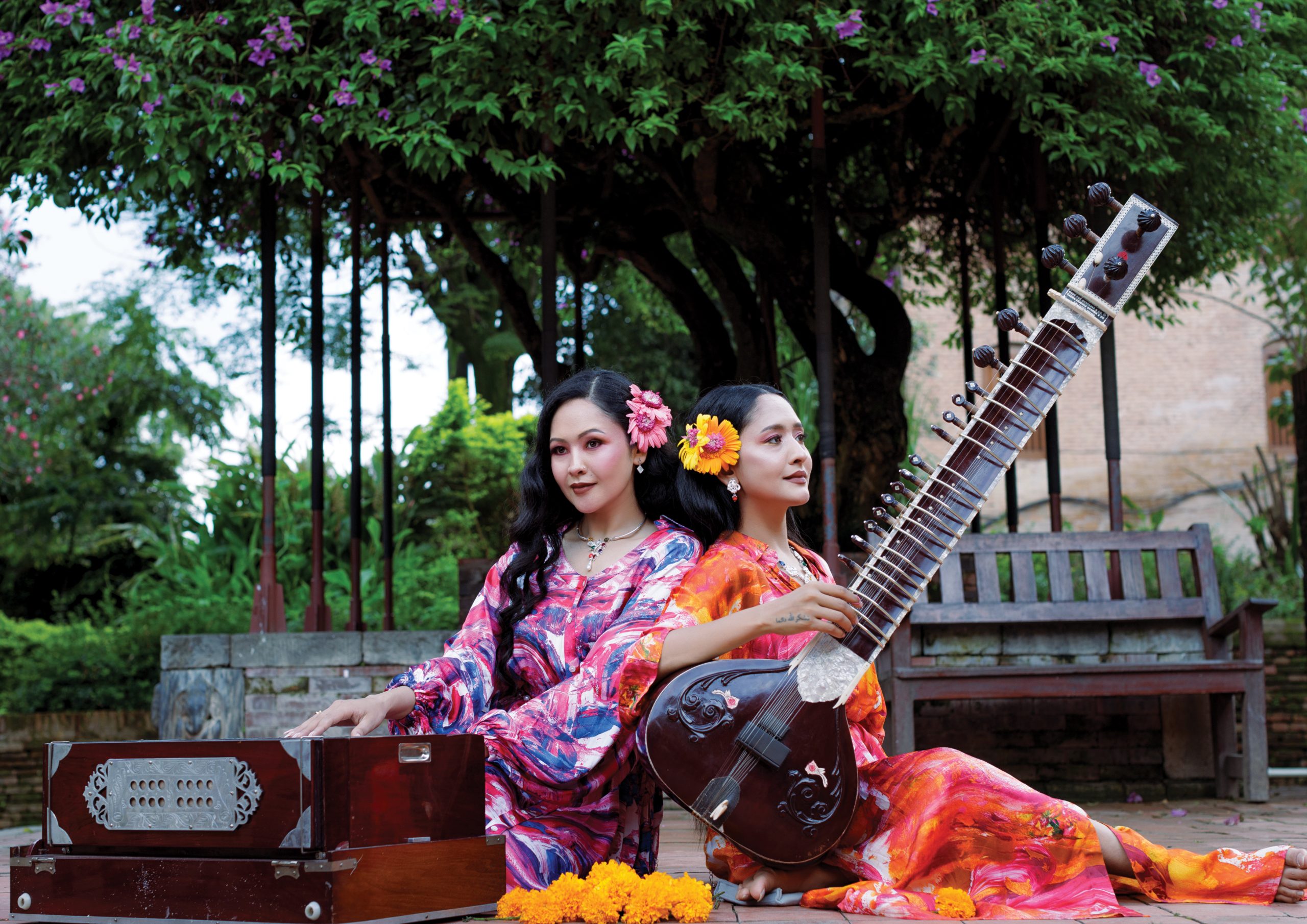
Some sounds do more than fill a room. They carry memories. They bring back a particular afternoon, a familiar face, a festival spent surrounded by family. For many Nepalis, music is inseparable from celebration, woven into festive gatherings, religious rituals, family traditions and the songs passed from one generation to the next.
For sisters Saraswoti and Puja Khatri, music is more than a cultural inheritance. It is a language they have grown up speaking together—one through the voice and the other through the strings of a sitar.
Their musical journeys have evolved alongside one another, yet each sister has found her own distinct expression. Saraswoti, a classical vocalist, first discovered her connection with music at school, where the appreciation she received encouraged her to keep singing. What began as an interest gradually became something she wanted to pursue seriously. Today, she is a vocalist with Sur-Sudha, the legendary Nepali band that has been part of the country’s music scene since 1989, a journey that has taken her across the world and onto stages before heads of state.
“I didn’t know where it might lead,” she recalls of those early days. “Over time, that love and connection with music led me to take it seriously.”
Despite the experiences and recognition she has received, Saraswoti remains grounded in the belief that she is still learning. For her, music is both personal and professional, but its greatest power lies in its ability to bring people together. “Music brings peace and connects all people around the world,” she says.
Puja’s relationship with music has been similarly transformative. Having studied the sitar for around eight to nine years, she still describes herself as a learner. For her, music has become part of who she is—a source of peace and a means of expressing emotions that words sometimes cannot capture.
“Music, for me, is much more than performing. It has become a part of who I am,” she says.
Two Sisters, One Musical Language
Before they were performers sharing stages, Saraswoti and Puja were simply sisters growing up together. That shared history has become one of the most meaningful parts of their musical relationship.
Both are members of Sur-Sudha, and their paths have naturally intertwined through music. Saraswoti describes their relationship as one of instinctive understanding, shaped by growing up together and learning classical music at a time when the genre itself continues to evolve.
For Puja, Saraswoti has been an important part of her growth as a musician. Her sister’s presence has brought opportunities, encouragement and, perhaps most importantly, confidence.
“She has always supported and encouraged me and given me the confidence to explore myself as a musician,” Puja says. “Having her beside me has made this journey feel much more meaningful.”
That closeness translates naturally when they perform. Years of being with each other mean that communication does not always have to happen through words. A gesture, a glance or even silence can become part of their musical conversation. “We can understand each other through the music, small gestures, and even silence,” Puja explains. “That familiarity makes our performances feel very natural and personal.”
Yet their musical identities remain distinctly their own. Saraswoti is a vocalist whose repertoire spans semi-classical ghazals, modern songs, spiritual bhajans, kirtan and mantra chanting, while Puja has developed her own musical language through the sitar.
“I think that difference is what makes our musical relationship special,” Saraswoti says. “We bring our own sensibilities to music, while supporting and complementing each other.”
Like any siblings, they may not always agree. But their shared understanding ultimately brings them back to the same place: the music. “Ultimately, we let the music bring us together,” Saraswoti says.
Sounds That Become Memories
There is perhaps no time when the relationship between music and memory feels stronger than during Dashain.
For Saraswoti, the Malshree Dhun and Mangal Dhun immediately transport her back to childhood. The familiar melodies bring with them memories of family, celebration and festive moments spent together. “As I’ve grown older, I’ve started to understand and appreciate music more deeply by heart,” she says. What was once simply the beautiful sound of Dashain has become something larger—a reminder of “our roots, our memories, and our Nepali musical heritage pride.”
That emotional connection to heritage is central to Saraswoti’s understanding of music. Although she works across genres—from classical and folk to modern, fusion, mantra and kirtan — she continually returns to the depth of Nepal’s musical traditions.
“What inspires me most about Nepal’s musical heritage is its depth, emotion, and connection to our identity,” she says. Traditional music, she believes, carries the stories, histories, languages, religions and cultures of the communities that created it.
For Puja, the gateway into this world is the beauty of raag and the sound of the sitar. “I feel classical music has a different kind of depth,” she says. “It allows you to slow down, listen, and really feel the music.” Her hope is that young listeners can encounter classical music without seeing it as something difficult or distant.
Keeping the Roots, Finding New Ways
For musicians like Saraswoti and Puja, carrying tradition forward comes with a delicate responsibility: how do you keep something authentic while allowing it to evolve?
Their answer is not to choose between tradition and modernity, but to allow the two to exist together. Saraswoti believes the way traditional music is presented needs to change with the times. New arrangements, technology and contemporary platforms can make classical and traditional sounds more accessible to younger audiences. But the essence of the music must remain untouched. “The roots should always remain,” she says.
Puja similarly sees social media and digital platforms as an opportunity to introduce traditional music to an entirely new audience. But she stresses that accessibility should never come at the expense of discipline. “We can embrace new things while still respecting our roots and taking the time to learn properly,” she says.
It is a particularly relevant perspective for a generation accustomed to discovering music through streaming platforms, short-form videos and constantly shifting trends. The sisters understand that tradition must find its way into these spaces if it is to remain part of the cultural conversation—but they also understand that centuries of musical knowledge cannot be condensed into a viral clip.
A Legacy Still Being Written
Neither sister speaks about music as though her journey has reached its final chapter.
Saraswoti, despite international performances and years of experience, openly acknowledges that she is still learning. Puja, after nearly a decade with the sitar, says the same. Their shared willingness to remain students may be one of the most important things they represent to the next generation: that mastery does not mean knowing everything, but continuing to listen, learn and grow.
For Puja, the future is ultimately about sincerity. “I hope our music represents our love for our tradition, but also our own journey and individuality as musicians,” she says. Years from now, she hopes their story will be remembered for “the sincerity, consistency, discipline and joy” they found in sharing music together.
And perhaps that is what makes the sisters’ story resonate beyond music. Their journey reflects a larger shift taking place in Nepal’s cultural landscape. A younger generation is inheriting classical and traditional forms while finding new ways to interpret, perform and share them. The instruments may find new stages. The songs may reach new audiences. The arrangements may evolve. But the emotional core remains.
Saraswoti carries tradition through her voice; Puja through the sitar. Together, they carry something even more enduring: the understanding that heritage is not something meant to sit untouched in the past. It is something to be learned, lived and passed on.