
A sweet shop, a community-led brand, and a socially driven venture—three businesses built on what Nepal already has, betting everything on making sure it doesn’t disappear. By Prabha Thapa Magar | Kathmandu
Built on Heritage The Businesses
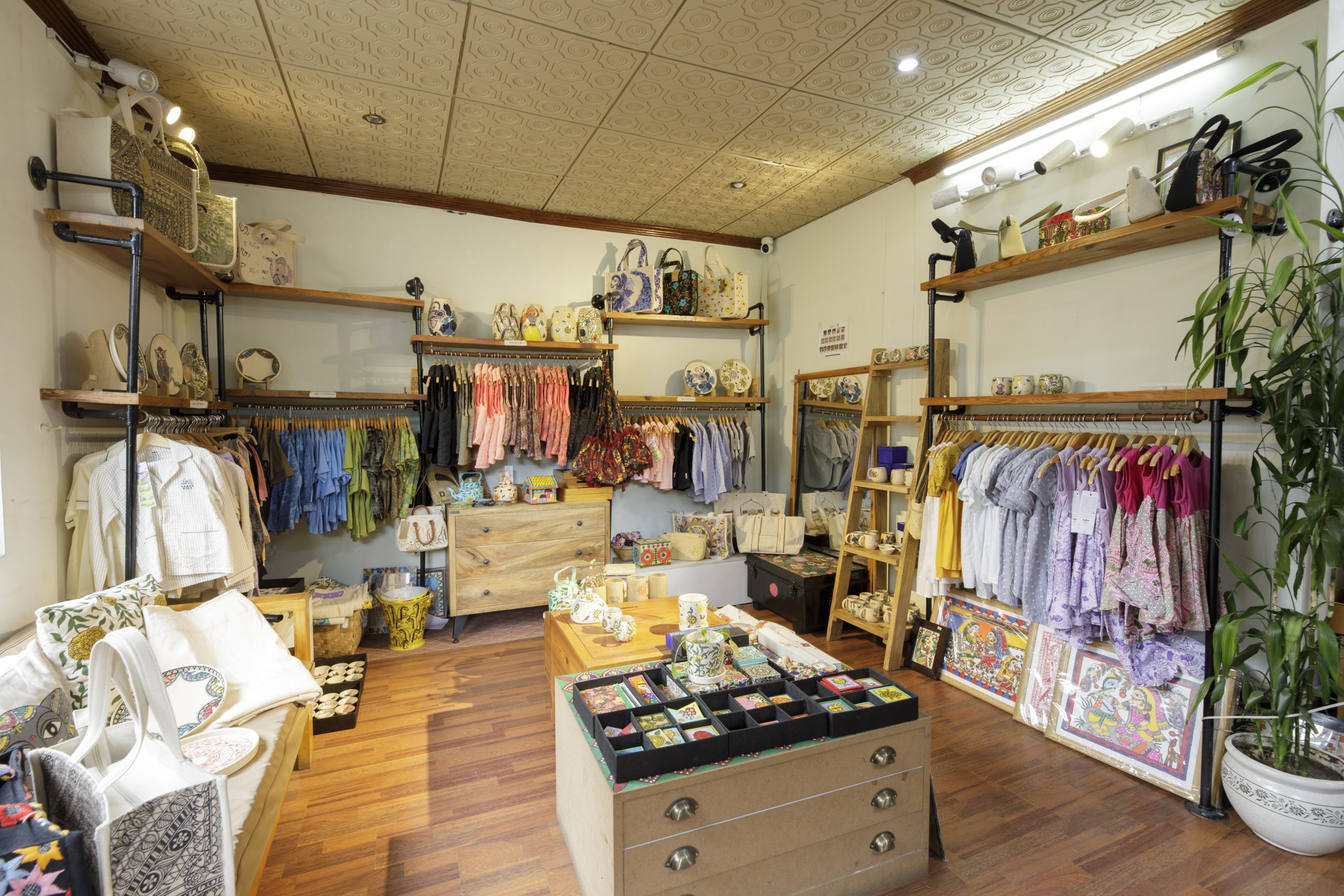
Nepal’s heritage businesses rarely look like businesses at first glance. They look like a queue outside a sweet shop, a small workshop where an artisan is still stringing beads by hand, a room where a tote bag is still being embroidered the old way. But behind that ordinariness sits a harder decision, made and remade every generation, to keep doing something by hand, at a human pace, in a country where it would often be easier—cheaper, faster, less fragile—to stop.
What ties these businesses together isn’t nostalgia. It is a kind of stubbornness. The skills involved —Newari sweet-making, traditional embroidery, artisanal jewellery and craft—are all, in their own ways, disappearing skills, held onto by fewer hands with each passing decade. The people keeping them alive are not doing it because it’s easy money. They are doing it because someone has to, and because they have either grown up knowing how or gone out and learned it, artisan by artisan. Some inherited that responsibility by blood. Some chose it, later in life, after years spent doing something else entirely. Either way, the businesses that come out of it end up carrying more than a product; they carry a community, a set of hands, sometimes a whole family’s reason for being.
Né Nepal is a story of the second kind. Ishu and Tulja had been friends for over 30 years by the time they reconnected while both working in Mumbai, and found themselves circling back to the same question: what if they went home to Nepal and paid real attention to the artisans behind its handicrafts? What followed was less a business plan than a homecoming. They quit their jobs, moved back, and spent a stretch of time simply meeting artisan after artisan, trying to understand what was thriving in Nepal’s craft economy and what was quietly disappearing.
Eight years on, Né Nepal works across jewellery, home décor, tableware, and wellness, and its founders will tell you, without much hesitation, which number matters most to them. Not the stockist in Patan, not the shelf at New York’s Museum of Art & Design, not even the presence inside Nilaya Anthology in India. It’s this: they started with four artisans. Today, that number is 178. “Real people, real families, real livelihoods”, as Tulja puts it, a number they intend to keep growing.
That same instinct for community produced Sangai, Né Nepal’s gathering space. Their first-ever session was held in a small coffee shop; they had no real sense of who, if anyone, would turn up, and almost 12 women did, each leaving the afternoon with something more than they’d come for. Sangai grew through the pandemic into something closer to family, held together online and in person ever since. Being young women building a serious business had its own friction, mostly in rooms where financial or growth conversations demanded they prove themselves before anyone would lean in—a discomfort Tulja says the brand’s track record has since done most of the arguing against. What keeps them in it, is watching an artisan’s income grow, or a young person choosing to stay in the trade because it now offers a real, dignified livelihood.
If Né Nepal’s heritage was something Ishu and Tulja went looking for, Badri ko Halwai’s was never a choice to begin with; it was simply handed down. Prajeet Tamrakar is the fifth generation to run the shop. It began, he says, with his grandfather’s grandmother, Nani Beti Tamrakar, whose brother was a Rajkarnikar—Halwai, as it’s known today. She married into Patan, bought land, and began supplying sweets to Judha Shumsher Rana’s palace. That was 114 years ago. The name on the shop today, Badri, belongs to Prajeet’s grandfather—given to the business by a son who lost his father at 12 and, unable to serve him in life, chose to serve his memory instead.
For most of that history, it was the women of the family who ran the business. Prajeet’s 84-year-old grandmother still checks in on how the shop is managed, still has opinions on what needs to change. What’s come down through the generations isn’t just a name but a set of hands, the specific skill needed to make Newari sweets like Lakhamari, Chara, and Macha, items so tied to ritual that they mark a Newar’s life from birth to death. Prajeet left a career in photojournalism to return to the family business, the way his volleyball-playing father once set aside his own game for it. “Only in very remote areas is it still going on”, he says of the wider trade. The real threat to shops like his isn’t Indian competition on taste or price; it’s a shrinking number of people willing to learn the craft at all.
It’s not just fewer hands carrying the tradition forward, either; sometimes the rules meant to regulate food safety end up working against it instead. Some of the shop’s traditional items, like colourful puri and Lwang Ful, are made purely as offerings for the gods and were never meant to be eaten. Buyers have always known that. But local authorities have banned their sale anyway, treating them as food rather than ritual objects—a well-intentioned rule that, in practice, just chips away at a tradition Prajeet feels the government should be protecting, not restricting.
Ask him what success looks like, and he doesn’t talk about scale or numbers. It’s simple: keep the business going long enough to pass it on to the next generation, the way it was passed to him.
Where Badri ko Halwai runs on bloodline, Danfe runs on something closer to conviction. Kritishma, co-founder of Danfe, describes the brand’s early days as “trials and tribulations,” and there’s an honesty in that phrase that runs through everything else she says. Danfe grew out of the development sector, not the fashion industry, and the business side of things—margins, scale, sales —felt unfamiliar to her at first. What didn’t feel unfamiliar was the intention: to build something sustainable alongside its impact partner, SAATH, whose livelihood training now supplies nearly half of Danfe’s production team. Danfe works in Mithila art, embroidery, crochet, and knitting; Kritishma calls these crafts hidden gems, overshadowed by faster trends but full of something modern manufacturing can’t fake: sweat, patience, and hope, woven into thread by hand.
Ask her about one of the artisans she works with, and she doesn’t hesitate—Saraswoti, whose smile she calls one of the best she’s ever seen, and with whom Danfe made its very first tote, now named in her honour. “We’re never here to change,” Kritishma says, “but to add a little of what we have to what they already have.” In a community where women are still fighting to be seen as equal, Saraswoti’s quiet, unglamorous independence is exactly the kind of impact Danfe set out to create.
That mission brings its own very specific headache: explaining again and again why handmade costs what it costs. “We’re not cheap. We’re not,” Kritishma says plainly. Made in Nepal, made by hand, without the scale of mass production, will always sit at a different price point than an import, and Danfe has made peace with reaching the people willing to pay for the work they actually see, rather than chasing everyone. What matters more to her is that the product speaks for itself, that people fall for it before they even hear its story. Success, to her, is numbers that mean something bigger: an international shelf, more communities reached across Nepal, more of the country’s art and heritage carried out into the world. As she puts it, Danfe is on a flight—destination set—still building the momentum, capacity, and courage to get all the way there.
A sweet shop, a craft house born of friendship, and a social venture—different roots, different reasons for starting. But talk to Prajeet, Tulja, and Kritishma long enough, and the same challenge surfaces in each: not making beautiful things, which all three have clearly solved, but making sure someone still knows how to make them in 10 years. Each is betting that heritage can keep growing rather than sit behind glass. That’s worth watching, and worth purchasing from them.