A celebration of food, family and tradition, through the rituals and recipes that make a Nepali Dashain table unforgettable. By ROHINI RANA| Kathmandu
A Feast Called Dashain
The festival of Dashain, or Bijaya Dashami, is Nepal’s largest festival, celebrating the triumph of good over evil. The country comes to a standstill as even the government machinery grinds to a halt for a week-long holiday. Kathmandu’s streets wear an unusual silence, not due to curfew or mourning, but because those who come to the city seeking livelihood and employment return to their homes in the hills and Terai.
The week brings a kaleidoscope of feasts, family, religion and tradition. Communities dress in new clothes, visit temples, meet relatives and embrace nonstop festivities. It is a homecoming, a season of blessings, laughter, old stories and, perhaps most importantly, food. The religious significance of the celebration is sometimes overshadowed by the feasting that accompanies the pujas. Dashain is a uniquely Nepali amalgamation of tradition, religion, culture
and cuisine.
The festival begins with Ghatasthapana, the ceremonial invocation of Goddess Durga in her many forms to enter homes and bless their inhabitants. Her presence is embodied in a kalash placed on a bed of sand strewn with barley seeds. During the nine days of Navratri, the Nav Durga temples are visited by all and sundry, with every shade of red, dominating what women wear.
Phulpati marks the seventh day of the 10-day festival. It is traditionally marked by the bringing of nine types of sacred plants from the Gorkha Durbar to Hanuman Dhoka, accompanied by a grand ceremonial military parade by the Guruju Paltan.
On Dashami, the tenth day, elders place red tika (rice mixed with vermillion) on the younger generations and bestow their blessings, along with jamara, the sprouted light-green barley shoots.
The excitement surrounding this festival of joy is immense. Prayers for blessings, new clothes and feasting are its central themes. Children are especially thrilled because they receive money from their elders along with blessings. Little girls, representing the goddess, receive special treatment throughout the festival and happily fill their fancy bags with dakshina.
The feasting that accompanies these days of celebration is astronomical, and the energy and aromas that fill the kitchens during Dashain have a way of awakening memories and reminding us that some of life’s happiest moments are created not in grand celebrations, but around a shared meal. Each family has its own Dashain repertoire: the same dishes handed down through generations and appearing each year because, without them, the festival would not feel complete. Traditional dishes provide continuity, while one or two new additions bring an element of surprise and novelty. Food becomes a language through which love is expressed.
The festival is also accompanied by the sacrifice of goats, chickens, ducks and buffaloes. A variety of dishes are made with the entrails and blood of the goat, with a strict no-waste policy applying; the head is considered a prized part. Wild boar preparations occupy a prominent place, while chicken and duck are also consumed in large quantities. Meal preparation starts days in advance, with the menu meticulously planned and traditional dishes occupying the heart of the table.
A typical non-vegetarian Dashain menu would consist of chicken pulao, chiura or phurandana, varieties of mutton and wild boar dishes, vegetables, mainly potatoes, and fresh pickles made from cucumber and tomatoes. In the old days, the famous mutton dish jamai ko masu was cooked entirely in ghee and spices. It lasted for a week without refrigeration and did not need to be reheated. It is slowly losing its charm because of the quantity of ghee used in its preparation, while refrigeration has largely solved the problem of preserving meat. Delicacies such as plain boiled or steamed bandel, khasi ko kawaf, pakuwa, bhutan and korma have retained their popularity.
Vegetarians have their own feast, with chiura, phurandana, tare ko aloo (fried potatoes), seasonal vegetables such as mismas tarkari, a variety of saag, kakro/golbhenda ko achar and a plethora of fresh and aged achars. The fermented cucumber pickle generally prepared at this time is called khalpi, made from bhadaure kakro harvested during the late monsoon. Cucumber chunks are sun-dried and mixed with mustard, salt, turmeric powder and chillies. It is delicious and provides a perfect counterpoint to rich meat dishes.
Desserts such as juju dhau, sikarni, sel roti, julphi swari, yomari, lakhamari and other sweetmeats are laid out and replenished constantly as relatives visit, receiving their fill of food and blessings.
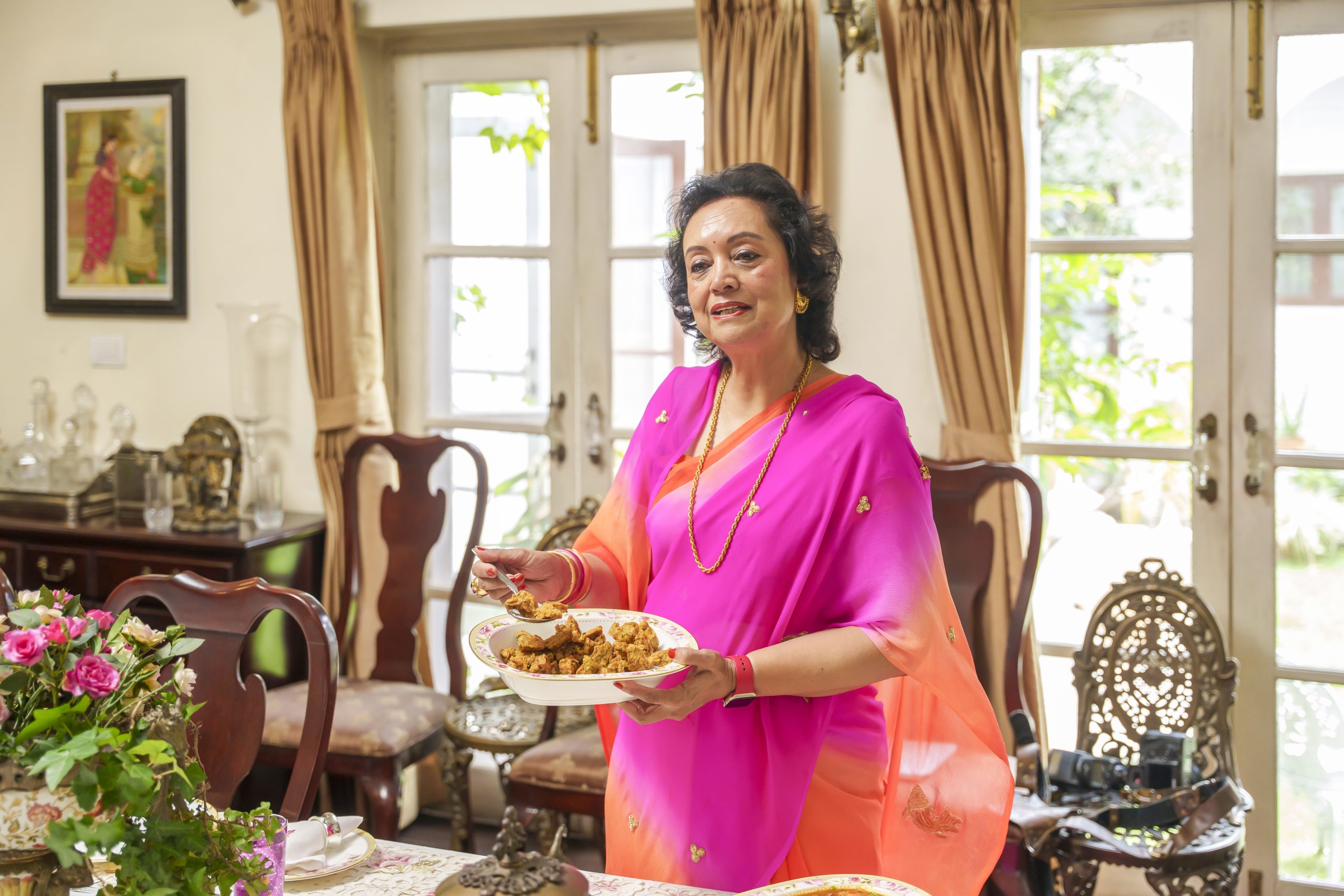
Dashain is the one festival when everyone makes an effort to visit relatives and take tika from them. Houses are cleaned and decorated, gardens are manicured, and inhabitants dress in their festive finery, irrespective of financial status. Tables are laid out for an ‘open house’, as relatives may drop in at any time of the day, staying to feast and gamble into the night.
Rather than prepare a brunch or lunch, the hostess usually lays out a feast on the table to be consumed as and when guests arrive. Many families have started a new tradition of assembling at the eldest relative’s house or hiring a hall to accommodate all family members at once. This has made life easier and removed the stress of travelling to each family member’s house to take tika.
A feast should be a pleasure to the eyes; sizzling sounds, crisp, crunchy or tender textures, and the aromas of spices, meat and vegetables can make your taste buds respond even before you take the first bite.
The decoration of the table also adds to the experience and enhances the presentation of the food. It is advisable to plan the dishes, crockery and cutlery you will be serving beforehand. The table always looks beautiful with a few seasonal flowers, such as marigolds, adding colour to the presentation.
If you are entertaining in the evening, candles or clay palas can add a subtle glow to the dinner table.
Wishing you all a very happy Dashain. May Goddess Durga fill your homes with joy, abundance and good health!
DASHAIN OPEN HOUSE
Rohini’s top picks for Dashain feast. All recipes from her cookbooks.
DRINKS
- KO SHERBET WITH ROCK SALT AND MISRI
- TITAURA KO COCKTAIL/MOCKTAIL
- LAPSI MINT TWISTER
- LEMON AND MINT TEA
- GINGER LEMON ICED TEA
- ROSE INFUSION
Non-vegetarian
- CHARA KO PULAO
- PHURANDANA
- KWATI KHASI KO JHOL
- KHASI KO KAWAF
- BHUTE KO KHASI MASU
- KHASI KO KORMA.
- JAMAI KO KHASI MASU.
- BANDEL TARE KO
- CHARA KO LEDO
- MACHA TARE KO
- MACHA KO BARI
Vegetarian
- ALOO TATRE KO
- KAULI HARYO PYAJ
- KWATI KO JHOL
- MISMAS TARKARI
- BHARYO PHARSI BHATMAS
- ALOO CHUKAUNI
- CHYAU SANDE KO
- CHAMSUR PALUNGA KO SAAG
- KARKALO KO SAAG
- MULA GOLBHENDA ACHAR
- LAPSI KO ACHAR
Dessert
- JUJU DHAU
- JULPHI SWARI
- PAPAYA HALUWA
- SEL ROTI
- SIKARNI
- MASALA KO KHEER
Rana is the author of three cookbooks and a seasoned homemaker.