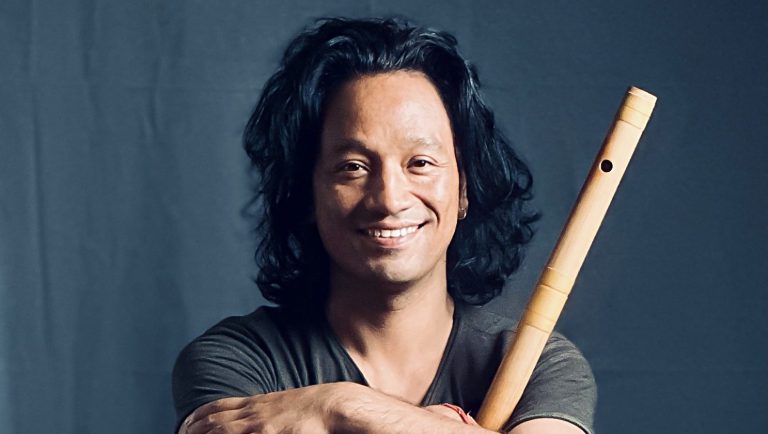
Echoes in the Valley is a free music festival that moves to a different tole each year and is planned with local residents. By: Anweiti Upadhyay | Kathmandu
Curating The Music Festival That Moves From Tole to Tole
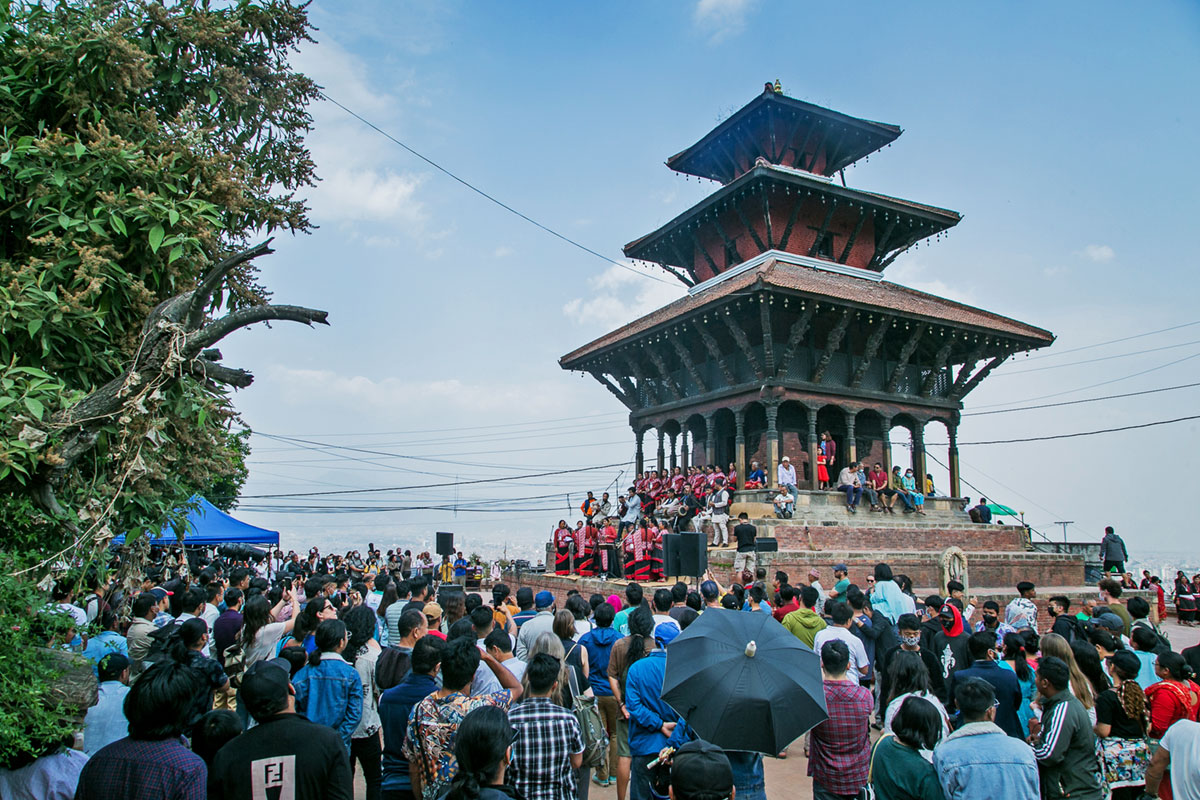
Echoes in the Valley music festival was started to give space to the folk and indigenous music that its organisers felt was being left out of Nepal’s festival calendar. From its first edition, the festival has maintained free entry for all; the artists and organisers have worked pro bono, and the stalls and workshops have been run by the residents of whichever tole hosts that year’s edition.
To date, 10 editions of Echoes in the Valley (EITV) have taken place. The first was held in 2017; it didn’t happen in 2020, and two editions ran in 2022. The most recent one took place in Khokana in January.
Each edition of the festival moves to a different locality. So far, these have included Ason, Banepa, Kirtipur, Bungamati, Thimi and various parts of Kathmandu. The 2021 edition was held online.
In every edition, the whole locality becomes part of the event. Residents run workshops, local musicians perform, and activities are planned for different age groups. Games and activities are arranged for children. Sessions that draw on local intangible knowledge are offered for older people.
These workshops are open to everyone. Local businesses set up stalls. The music itself must carry some element of ethnic or traditional practice from Nepal, though the artists may come from further afield.
“The aim,” says Riju Tuladhar, who is the co-founder and director of the festival as well as a musician (you might know him from the bands Kanta dAb dAb or Robin N Looza) and an educator at Kathmandu University’s Department of Music, “is to keep the focus on the people who live in the chosen tole and on the music and culture that belong there.”
And a lot of work, that begins months—sometimes even a whole year—ahead of the actual festival date, goes into making all this happen.
How it starts
Every year the team begins with a blank slate. The first step is a series of meetings with local-level offices, ward offices, municipalities and the various clubs in each tole. On average, the EITV team hold at least 40 of these meetings simply to get everyone on board for the festival.
Locals are often sceptical at the start. According to Tuladhar, local officials and residents tend to assume there must be a hidden motive when a festival of this scale is proposed without commercial gain for the organisers and without charging the public. “Selling the idea to them takes time and repeated discussion,” reveals Tuladhar.
These conversations are usually kept informal. The team works through the overall plan with the residents so that the local community feels it owns the event as much as, or more than, the EITV organisers.
Talks usually begin at least six months before the festival date. Sometimes they start a full year earlier. Official approval from the different local bodies is sensitive (can change at any moment) and slow. Only after all approvals are in place does the team print pamphlets, posters, and maps or publish the full festival details. That is why they put out these things only a few days before the event, even though the organisers would prefer to release them earlier.
The same careful process of discussion and shared planning is repeated each year, whatever the locality.
Location and Tangible Heritage
The first edition of EITV was held in Ason because it is Tuladhar’s own locality. “I thought the coordination process would be simpler this way as the local officers, ward staff and club members already knew me, both as a resident and as a musician from my work with Robin n’ Looza,” he admits.
That opening festival also set out to remind people why Kathmandu has so many dabalis—the traditional open stages found in Newa localities—and to put them back into regular use.
“If we don’t make use of the tangible heritage around us, we are disrespecting it. We have to breathe life into them by using them well,” says Tuladhar.
The same idea still guides every edition of the festival. When a chosen locality has no dabalis, the EITV team uses patis or chautaras instead.
While the organising team does their best to keep everything on track as the date of the festival gets closer, things do not always go to plan. In 2024, the organisers had been preparing the festival for Bhaktapur and shaping the programme around that town’s particular culture and traditions.
A month before the date, the mayor asked them not to hold it in Bhaktapur. The team then worked with residents in the core area of Itumbahal, added Hanuman Dhoka as a second site and reshaped the entire schedule and layout to fit the new places in a short time.
Each year the choice of locality is one of the most important aspects of the planning process of the festival. The team moves the festival that different communities can take part in and that the physical heritage of each place can be brought into active use.
Curating the Different Aspects of the Festival
Every activity is chosen so that it fits the location and draws on the strengths and traditions of the people who live there. The organisers also check that the distances and timings between stages, performance spots and workshop sites work smoothly for the audience and that nothing clashes.
The team also works to include as many female musicians as possible. In 2022 they began AmplifiHer, a hands-on music-production residency for women and non-binary participants drawn from different ethnic backgrounds.
According to Tuladhar, in a recent edition, women made up 51 per cent of the performing musicians. However, the most recent edition had fewer. The EITV team—Tuladhar in particular—is also mentoring several new groups of young female musicians who are preparing to play in the upcoming editions.
Co-founder and director Bhushan Shilpakar oversees the production of the maps and the pamphlet each year. He works with designers and artists to make sure both are clear and detailed.
Planning for the next edition begins as soon as the current one ends. The team collects feedback forms from attendees and uses the comments to decide what to keep, what to change and where improvements are needed.
After 10 editions, it has become harder to invent fresh activity ideas, yet several regular partners continue to take part. Workshops on lipis are one example; Alchi ko Pasal is another. Ethnomusicology students from Kathmandu University also offer proposals or present papers when the subject matches the theme and the place of that year’s festival.
Keeping artists, activity partners, volunteers and technical crew aligned throughout the short final period is another practical challenge that has to be managed each year. Tuladhar mentions he is constantly running around during the festival days, making sure everyone—especially the artists and workshop conductors—is in their allocated locations so that everything goes smoothly as planned.
Keeping it going
Running the festival without commercial partners has made things financially challenging for the EITV team. In the first year, the team raised money within their own community and paid every participating artist the same modest fee.
From the second year onwards, they have received financial support from various embassies, together with smaller contributions from the municipalities and wards that host the edition.
The organising team itself has worked unpaid from the start. Tuladhar notes that the success of the festival and the evident satisfaction of the residents, the audience and the artists are enough for them.
Alongside the festival, the same team launched the Nepal Music Archive in 2021, which is a digital collection of Nepali music resources, the first-of-its-kind in the country and it also works on digitising older analogue recordings. The archive grew directly out of the first EITV, when the organisers recognised the need for an accessible research portal for students, teachers and the wider public.
Each edition also has two scholarship placements: one at the Kathmandu Jazz Conservatory and one at Kathmandu University’s Department of Music. The schools themselves select the recipients.
Looking ahead, the organisers want to see still wider participation, both in the audience and on stage, across age and gender. They also hope to include a greater variety of local food and remain open to ideas
or pitches from
anyone who can help
them in this endeavour.